World Action Models for Whole-Body Humanoid Control

ζ0: A Framework for World Action Models with Joint Scene and Body Foresight in Humanoid Control

Yizhi Chen1,2,*, Zhanxiang Cao3,2,*, Yitong Wang3, Junyu Liu4, Hongchu Zeng3, Xinyi Peng5,2, Chuxuan Huang6,2, Yicheng Su6, Zihao Zhou3,2, Shengcheng Fu1,2, Haoyang Li3,2, Liyun Yan3,2, Tianyue Zhan3,2, Jianming Ma3,2, Yang Zhang3, Keqi Zhu5,2, Xiaxi Si3, Jinming Yao7, Qiao Sun8, Shizeng Zhang8, Jiangwei Zhong8, Yue Gao3,2,†
1 Tongji University logo Tongji University
2 Shanghai Innovation Institute logo
3 Shanghai Jiao Tong University logo Shanghai Jiao Tong University
4 Shanghai University logo Shanghai University
5 Zhejiang University logo Zhejiang University
6 Fudan University logo Fudan University
7 USTC logo
8 Lenovo logo
*Equal contribution · †Corresponding author
Paper PDF 18 pp Code & Data GitHub BibTeX
79.5% +9.0 / +18.8 pp
HumanoidArena 7-Task Mean
GR00T N1.7 & Ψ0 · top joint policy
85.0% +10.0 / +16.7 pp
Real-World Unitree G1 (6 Tasks)
300 physical trials · +26.7 pp multi-stage (Ψ0)
4.5° vs. 9.4° hold
29-Joint Body Forecast (+0.6 s)
Beats pose persistence in 83.5% of 526 windows
212 ms 6.3 GiB
Closed-Loop Policy Latency
Single RTX 4090 · 1 forecast / action chunk
1080p · 2:24 · English Narration & Subtitles
Full Narrated Presentation (2:24)
0:00 / 2:24
Chapters:

Complete narrated walkthrough of ζ0: motivation, joint scene-and-body future latent representation, dual-response transfer, HumanoidArena simulation, six real-world Unitree G1 tasks, and ablation analysis.

Physical Unitree G1 · 300 Autonomous Trials

Real-World Whole-Body Demonstrations

All five policies share three RGB cameras (head + dual wrists), 41-D measured state, and the SONIC whole-body controller. Across all six tasks, ζ0 reaches 78.3% on Ψ0 (+16.7 pp) and 85.0% on GR00T N1.7 (+10.0 pp), with the largest gains on multi-stage long-horizon tasks (+26.7 pp on Ψ0; +13.3 pp on GR00T).

0:00 / 0:19 3rd-person + Head/Wrist PiP
HumanoidArena Benchmark · 1 Shared 7-Task Policy

Simulation: Synchronized Dual-View Explorer

Inspect why egocentric visual foresight alone falls short: the head camera sees forearms and objects ahead, while the robot’s legs, torso, and foot contact lie outside the field of view. ζ0 jointly forecasts scene dynamics and all 29 body joints from causal inputs.

Third-Person Whole-Body View Observer camera (not fed to policy)
Egocentric Head-Camera Input Exact visual input to ζ0 — legs out of FOV
0:00 / 0:00
Architecture & Training Objective

How ζ0 Works

Abstract

World Action Models anticipate visual outcomes to guide robot actions, yet humanoid interaction also depends on how the robot’s body responds. Visual foresight alone can miss body motion, while latent-distance losses do not directly supervise action responses. We present ζ0, a framework that turns vision-language-action policies into World Action Models by foreseeing future visual features and measured joint trajectories in a shared latent representation. During training, a teacher conditioned on recorded futures provides a reference action response, and dual-response transfer trains the causal predictor to match it through both the teacher and the executing policy. All components are trained jointly, and deployment uses only causally predicted futures.
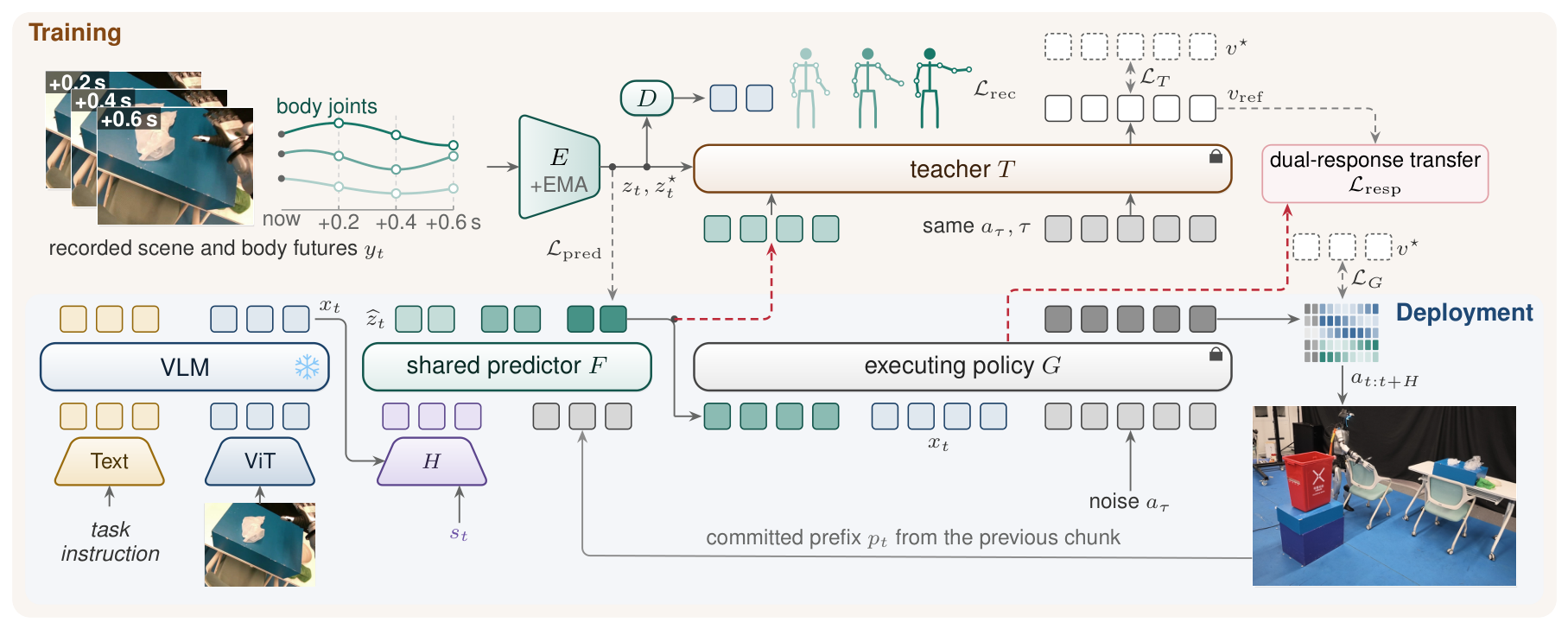
Overview of the Zeta-0 framework showing training and deployment pathways Click to enlarge
Figure 2. Overview of ζ0. Bottom (deployed): the base VLM encodes the instruction and current view; conditioner H and shared predictor F predict a latent future ẑt across three temporal groups (+0.2 / +0.4 / +0.6 s) to condition executing policy G. Top (training only): encoder E (with EMA target) summarizes recorded future visual features and 29-joint body trajectories; teacher T defines a reference action response vref, and dual-response transfer supervises ẑt through locked readers Tfix and Gfix.
01

Shared Scene & Body Future Latent

Encodes future post-merger visual features and 50 Hz measured 29-joint body trajectories (14 arm, 12 leg, 3 waist) into 3 × 8 × 256 tokens spanning +0.2, +0.4, and +0.6 s. Captures real contact and balance rather than commanded actions alone.

02

Dual-Response Transfer in Action Space

Equal latent-distance errors can induce vastly different actions. A privileged recorded-future teacher T provides a reference flow velocity vref; matching it through both locked Tfix and deployed Gfix aligns predicted foresight directly with control.

03

Base-Agnostic & Lightweight Deployment

Attaches cleanly to distinct VLA architectures—an 8-layer flow head (Ψ0) and a 32-layer DiT cross-attention head (GR00T N1.7). At inference, E, EMA, D, and T drop away; F runs once per action chunk (212 ms on one RTX 4090).

Quantitative Evaluation & Analysis

Benchmarks, Ablations & Body Foresight

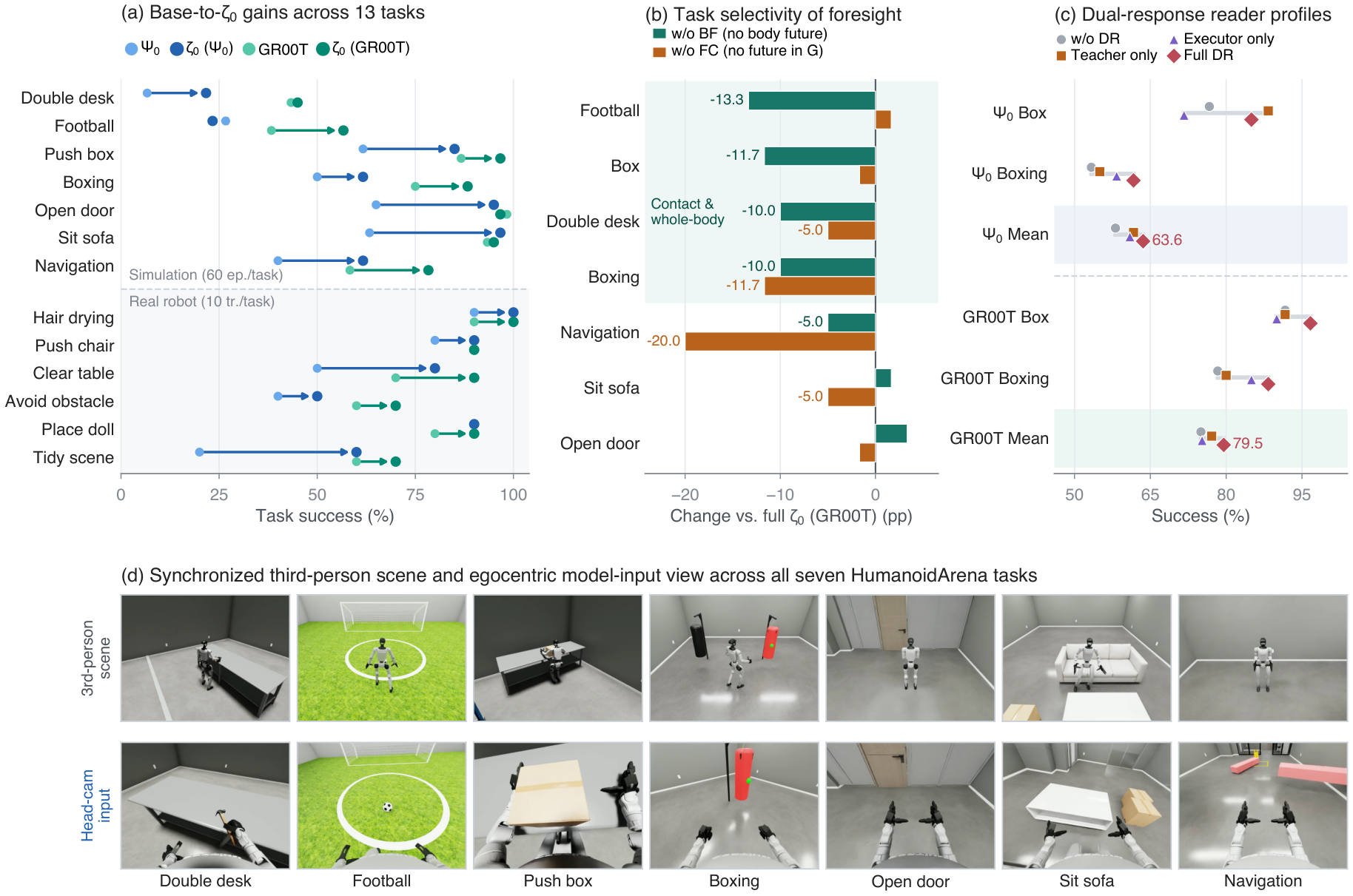
Key Finding: On seven HumanoidArena tasks (420 closed-loop episodes per policy), ζ0 lifts Ψ0 by +18.8 pp (44.8% → 63.6%) and GR00T N1.7 by +9.0 pp (70.5% → 79.5%), topping every compared seven-task joint policy.
Policy Double desk Football Box Boxing Open door Sit sofa Navigation Mean (%)

Published rows retain source-specific settings (‡ average over base + 3 OOD modes; * additional policy pretraining). Our runs (bottom six rows) share 700 demonstrations, 40,000 updates, SONIC low-level control, and 60 episodes/task across scenario seeds 0, 1, 2.

Single-Stage Tasks (30 trials/policy)
Hair drying · Push chair · Place doll
All 5 policies reach 80.0%–93.3% (ζ0 hits 93.3% on both bases)
Multi-Stage Long-Horizon Tasks (30 trials/policy)
Clear table · Avoid obstacle · Tidy scene
Ψ0: 36.7% → 63.3% (+26.7 pp)  |  GR00T: 63.3% → 76.7% (+13.3 pp)
Policy Hair drying Push chair Clear table Avoid obst. Place doll Tidy scene Mean (%)

Success counts out of 10 randomized physical trials per task (60 trials per policy; 300 total). All five policies train separately per task on identical demonstrations for 20,000 updates.
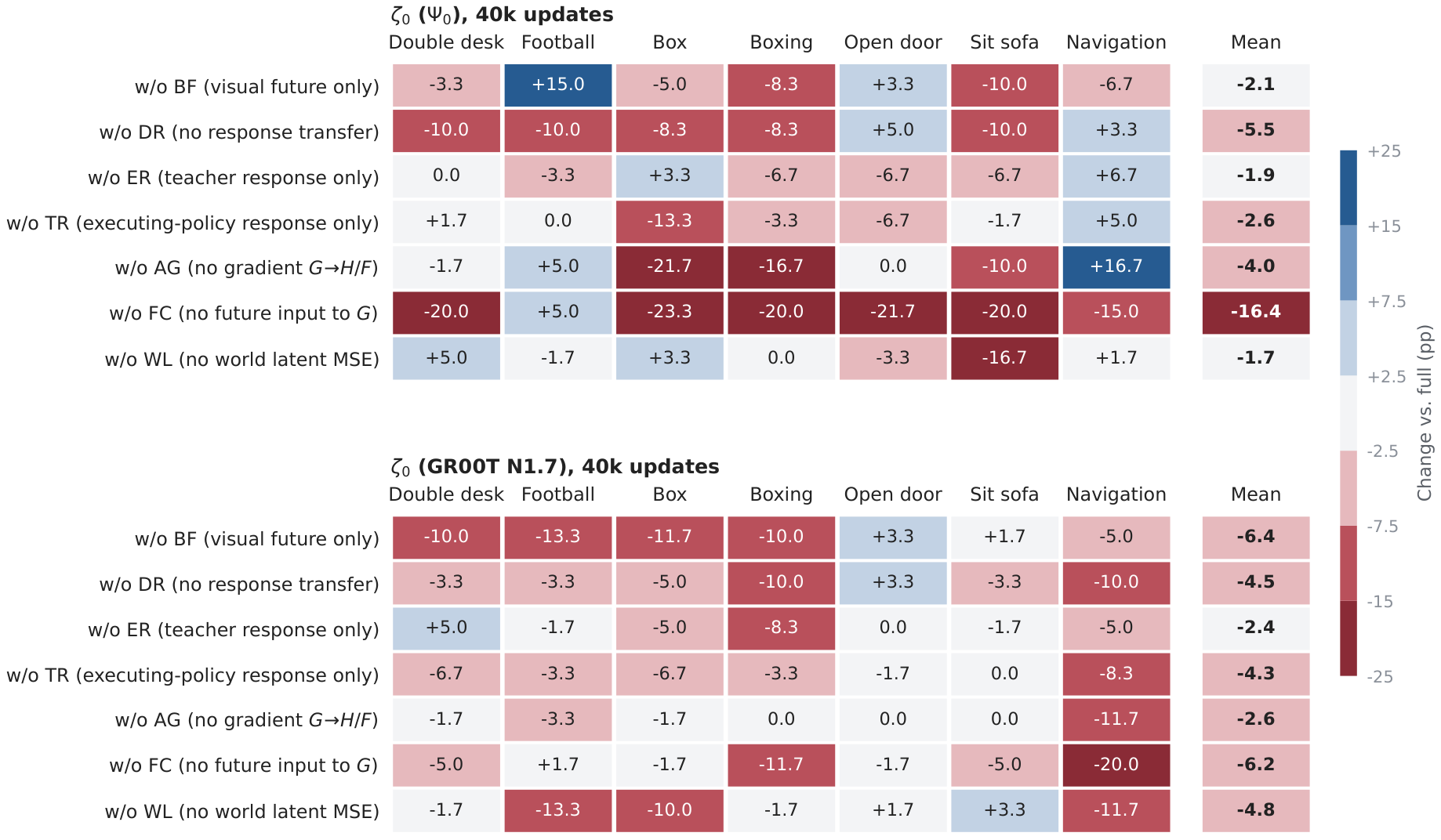
Every ablated component reduces seven-task mean success on both bases (420 episodes/setting). Removing future conditioning (w/o FC) causes the largest drop on Ψ0 (−16.4 pp), while removing body futures (w/o BF) causes the largest drop on GR00T (−6.4 pp), concentrated in contact-rich tasks (−10.0 to −13.3 pp).

Per-task ablation heatmap for both bases Click to enlarge
Per-task ablation heatmap (Fig. S3). Success-rate change in percentage points relative to the full model on each base.
Cross-benchmark gains and dual-response reader synergy Click to enlarge
Cross-benchmark gains & reader synergy (Fig. S4). ζ0 improves or matches its base in 24 of 26 simulation & real-world task pairs.
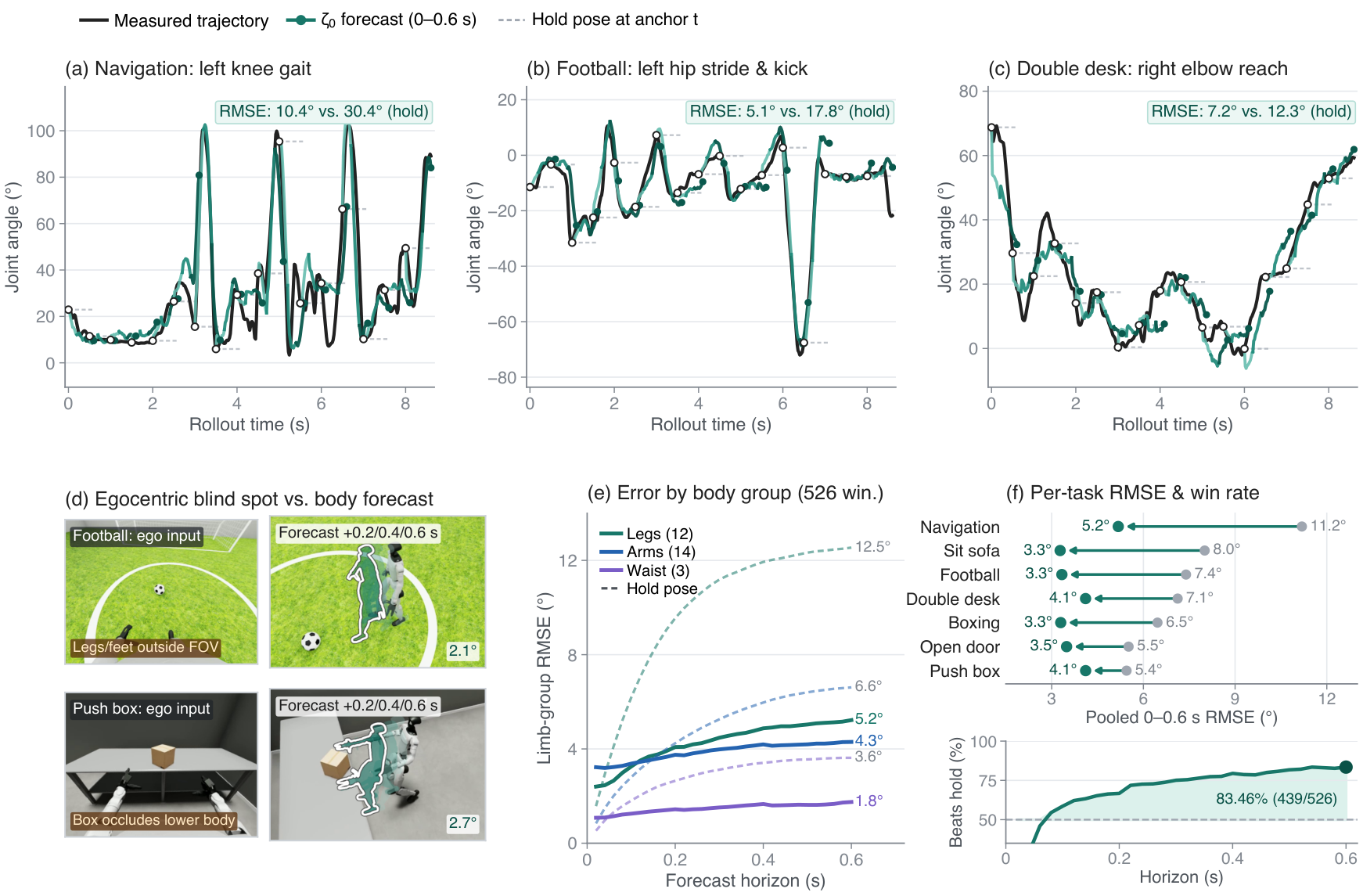
3.92° vs. 7.60° hold Pooled 0–0.6 s RMSE (29 joints)
4.53° vs. 9.36° hold Endpoint +0.6 s RMSE
5.23° vs. 12.54° hold 12 Leg Joints (+0.6 s, out of FOV)
83.5% 439 / 526 windows Win Rate vs. Pose Persistence
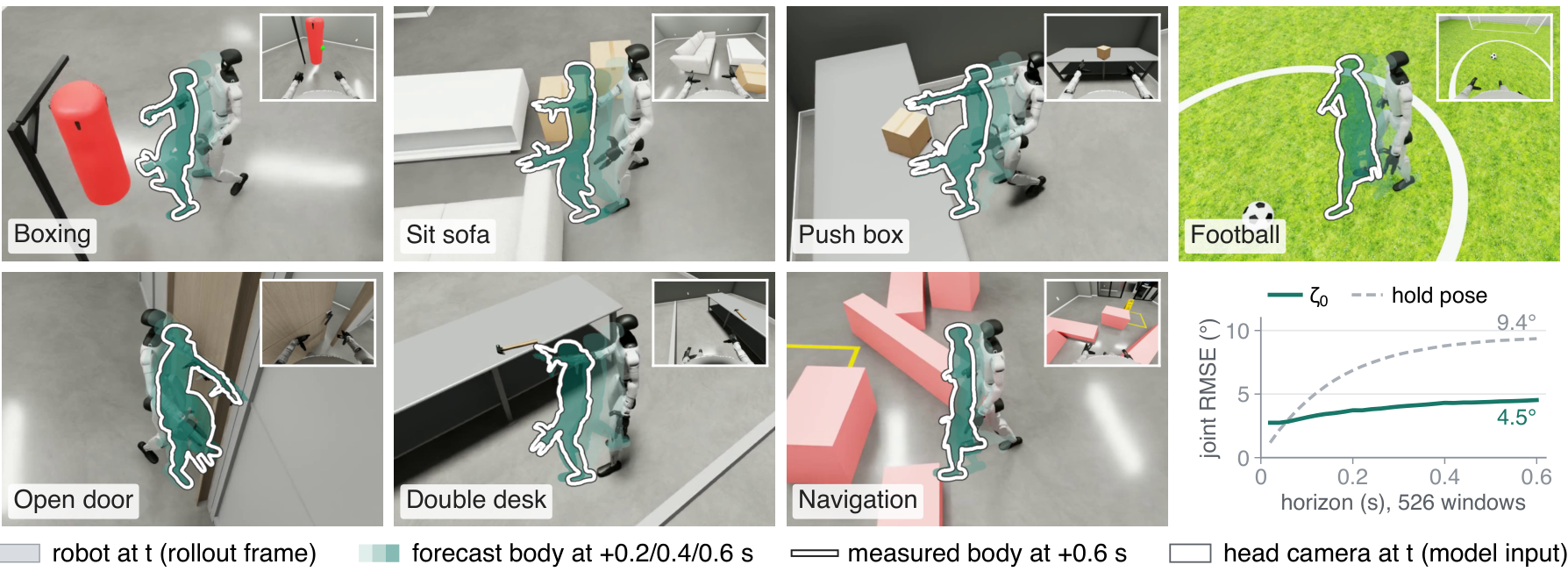
Body forecast rendered in scenes across seven HumanoidArena tasks Click to enlarge
In-scene whole-body forecasts (Fig. 3). Predicted +0.2 / +0.4 / +0.6 s poses overlaid with the measured +0.6 s outline across seven tasks.
Closed-loop joint trajectory forecasts and per-limb RMSE breakdown Click to enlarge
Closed-loop joint trajectories & limb breakdown (Fig. S5). Legs incur the largest drift when occluded and gain the largest error reduction.
Citation

BibTeX

@article{chen2026zeta0,
  title   = {$\zeta_0$: A Framework for World Action Models with Joint Scene and Body Foresight in Humanoid Control},
  author  = {Chen, Yizhi and Cao, Zhanxiang and Wang, Yitong and Liu, Junyu and Zeng, Hongchu and Peng, Xinyi and Huang, Chuxuan and Su, Yicheng and Zhou, Zihao and Fu, Shengcheng and Li, Haoyang and Yan, Liyun and Zhan, Tianyue and Ma, Jianming and Zhang, Yang and Zhu, Keqi and Si, Xiaxi and Yao, Jinming and Sun, Qiao and Zhang, Shizeng and Zhong, Jiangwei and Gao, Yue},
  journal = {arXiv preprint},
  year    = {2026}
}